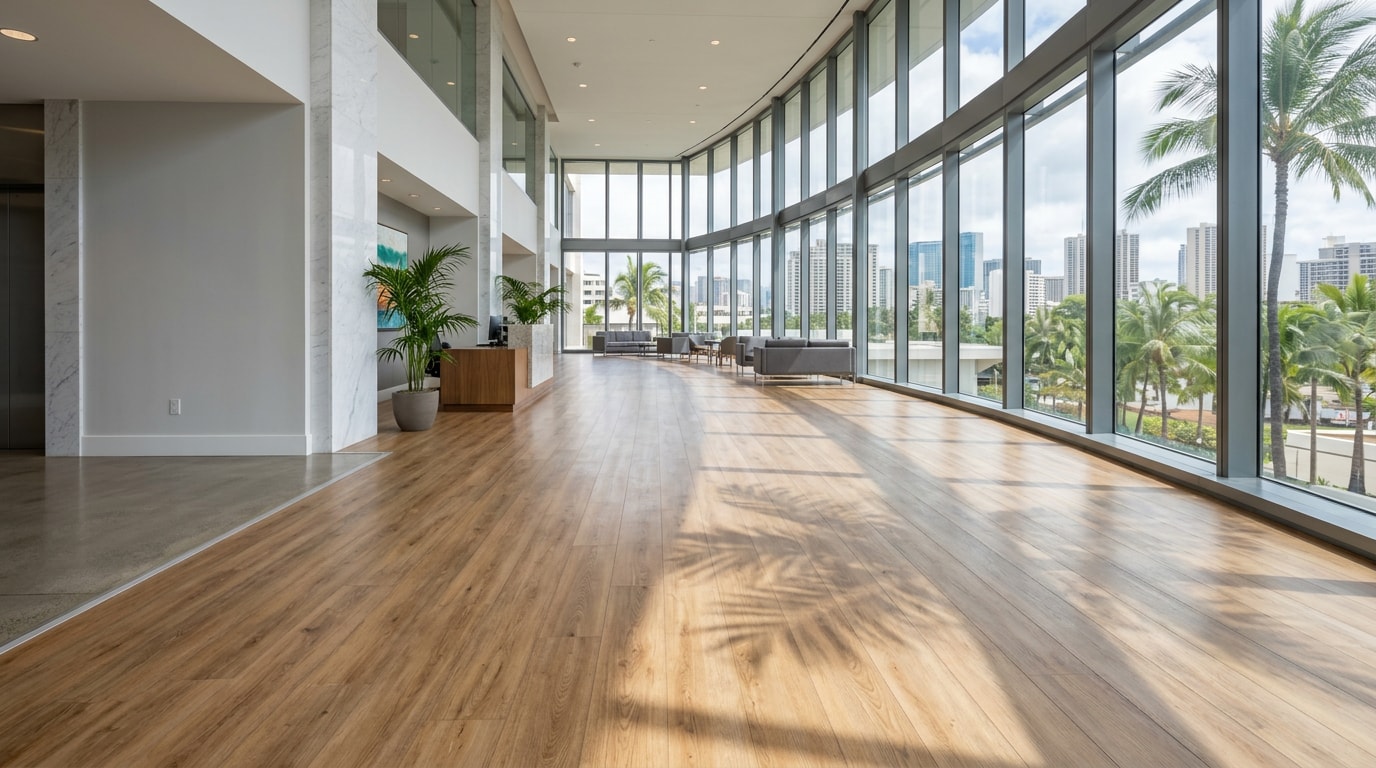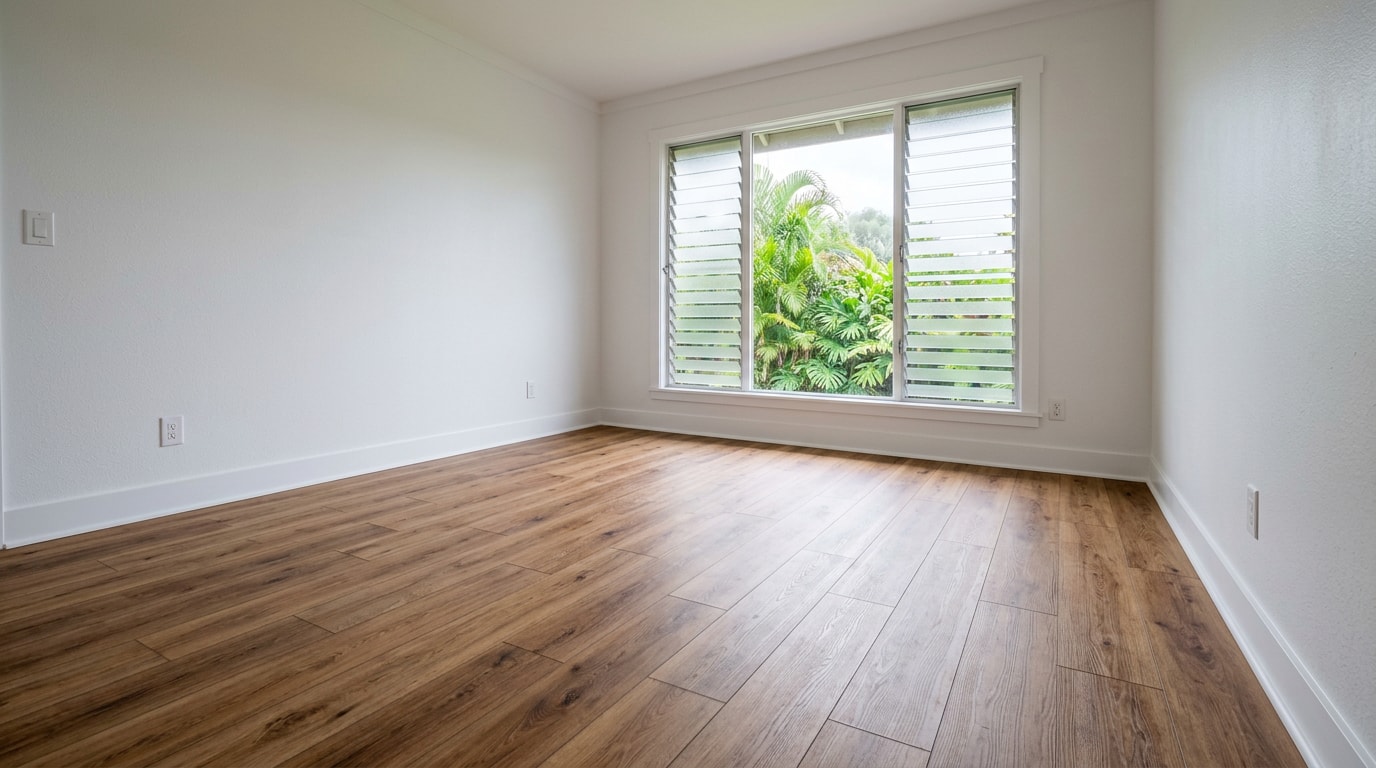
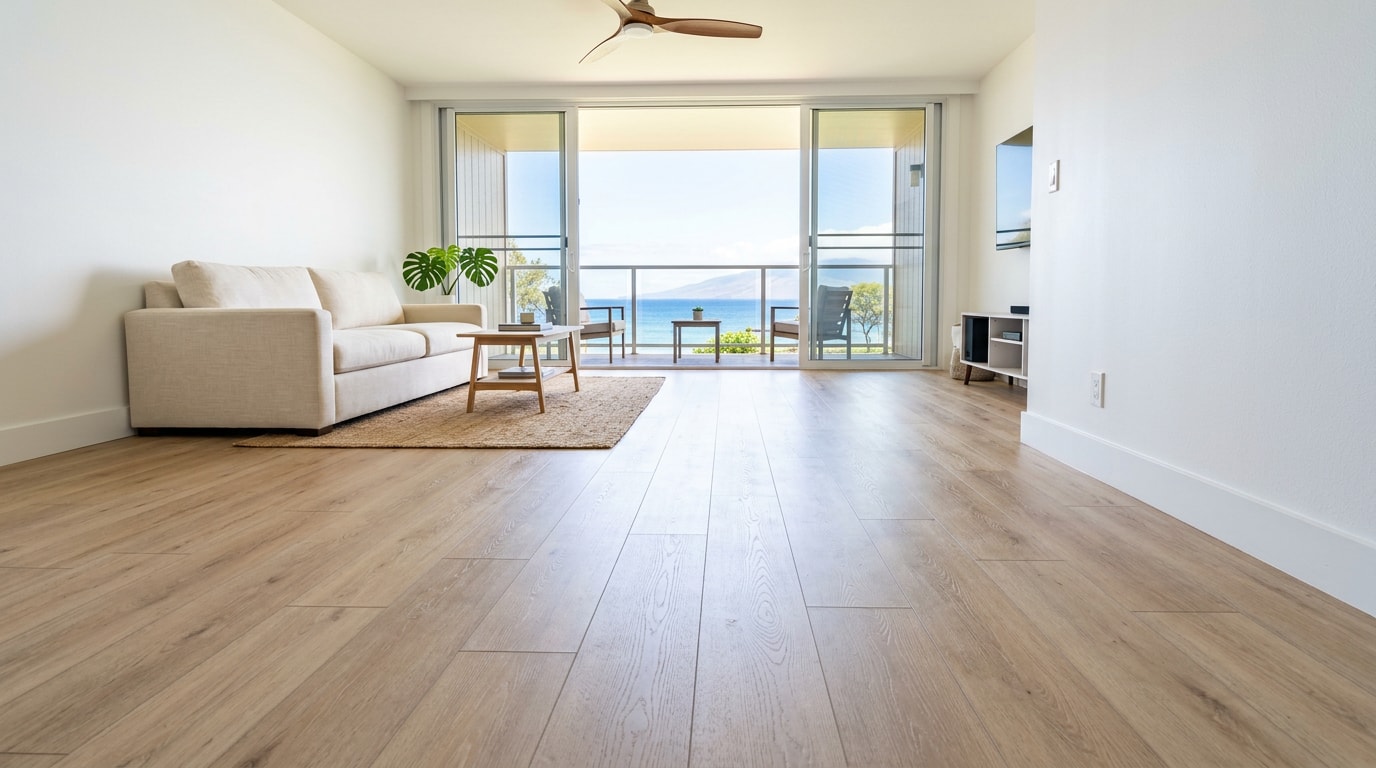
Laminate flooring is a multi layer synthetic plank that looks like wood or stone and clicks together over your subfloor, and in Kihei it is one of the cheapest ways to get a wood look floor that tolerates tracked in sand. The catch is that a lot of what sits in showrooms will not survive five years in a South Maui rental. Here is how laminate is actually built, what it costs, and exactly where it fails.
What Is Laminate Flooring?
Laminate flooring is a printed image layer bonded to a dense fiberboard core under a clear protective wear layer, all fused together with heat and pressure.
It imitates wood, stone or tile. It installs as a floating floor that clicks together over the subfloor instead of being nailed or glued down.
Three clarifications, because these get mixed up constantly:
- It is not solid hardwood. There is no real wood on the surface to sand or refinish.
- It is not engineered wood. Engineered planks use a genuine hardwood veneer over plywood.
- It is not vinyl. Vinyl planks are plastic all the way through, while laminate has a wood fiber core.
What you are buying is a synthetic plank with a photographic finish. That is why wood look flooring at this price point took over the market.
How Laminate Flooring Is Made: The Four Layers
The stack, not the brand name on the box, determines how the floor performs. A cheap plank and a premium plank can look identical in a showroom and behave completely differently three years in.
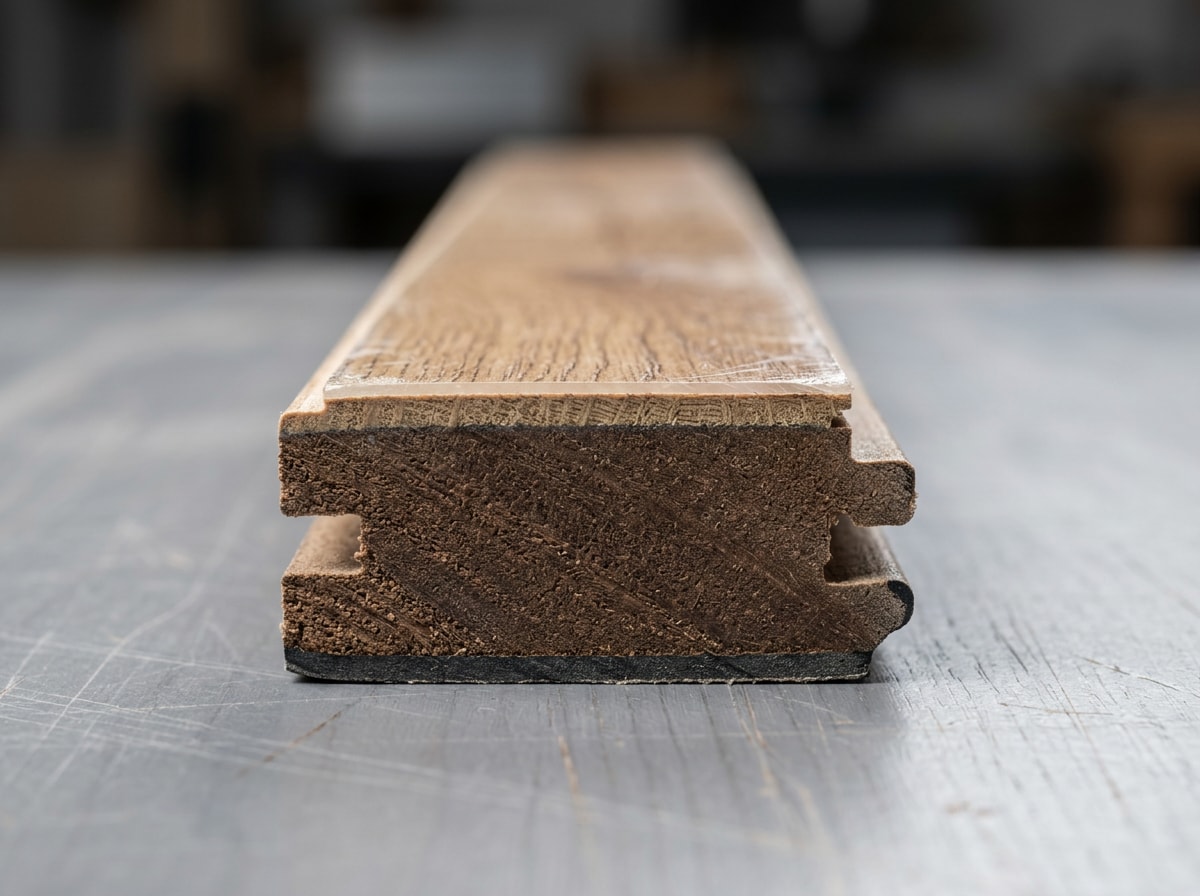
Wear Layer
The wear layer is a transparent coating on top, usually infused with aluminum oxide, one of the hardest materials used in flooring finishes. It is what makes laminate resist dog nails, dragged chairs and sand.
It also slows UV fading, which matters more here than most places. South Maui sun comes through sliders all year, and any floor sitting in that beam will lighten. A thicker, better rated wear layer buys you years before that shows.
Design (Image) Layer
Below the coating sits a high resolution photograph of wood or stone.
Better products use embossed in register texturing, where the surface grooves line up exactly with the printed grain, so the floor feels like what your eye sees.
Also check the repeat count: how many unique plank images the product uses. Low repeat counts are why some floors look obviously copy pasted across a room.
Core Layer
The core is typically high density fiberboard (HDF), though budget lines use MDF.
Core density drives almost everything you feel: dent resistance, how solid the floor sounds underfoot, and how the plank reacts to moisture. Denser is better in a humid coastal home.
Backing and Underlayment
A melamine resin backing adds stability and acts as a partial moisture barrier.
Some planks arrive with underlayment pre attached. Others need it rolled out separately. On a concrete slab, a separate vapor rated underlayment is usually the smarter call regardless of what came attached.
Laminate Flooring Cost in Kihei, HI (2026 Planning Ranges)
| Line item | Typical range per sq ft |
|---|---|
| Entry level laminate (6mm to 8mm, AC3) | $1.50 to $2.75 |
| Mid grade laminate (8mm to 10mm, AC4) | $2.75 to $4 |
| Premium laminate (12mm, AC4 to AC5, water resistant) | $4 to $5 |
| Underlayment and vapor barrier | $0.30 to $0.75 |
| Installation labor | $2 to $4 |
| Slab grinding or self leveling, when needed | $1 to $3 |
| Demo and haul away of old flooring | $1 to $2.50 |
These are our planning ranges for South Maui jobs, not quotes. Island freight, condo elevator restrictions, HOA work hour rules and subfloor condition move the number more than the plank you pick. You can see finished work in our project gallery or get a free estimate for your exact square footage.
Pros and Cons of Laminate Flooring
Pros
- Costs a fraction of the hardwood, stone or tile it imitates.
- Click lock installs fast over most existing subfloors.
- Aluminum oxide surface resists scratches better than real wood at the same price.
- Genuinely low maintenance: sweep, damp mop, done.
- Enormous range of looks, widths and textures.
Cons
- Cannot be sanded or refinished. Damaged planks get replaced, not repaired.
- Sounds hollow and clicky without quality underlayment.
- Harder and cooler underfoot than carpet.
- Seams are vulnerable to standing water.
That last point deserves its own paragraph. Even products marketed as water resistant depend on the locking joint and any factory seam treatment to keep moisture out of the core. Some lines carry specific waterproof ratings with time limited warranties. Read the actual warranty language rather than assuming laminate as a category is waterproof, because it is not.
Laminate vs. Hardwood, Vinyl and Tile
| Laminate | Hardwood | Luxury Vinyl Plank | Tile | |
|---|---|---|---|---|
| Material cost per sq ft | $1.50 to $5 | $5 to $15 | $2 to $7 | $2 to $15 |
| Installed cost per sq ft | $4 to $9 | $10 to $22 | $5 to $12 | $12 to $30 |
| Water tolerance | Low to moderate | Low | High | Very high |
| Refinishable | No | Yes, multiple times | No | Not applicable |
| Expected lifespan | 15 to 25 years | 30 to 100 years | 15 to 25 years | 50 or more years |
| Feel underfoot | Firm, wood like | Warm, solid | Softer, slightly flexible | Hard, cool |
| Resale impact | Neutral to slight plus | Strongest | Neutral | Strong in wet rooms |
| Humid coastal behavior | Needs expansion gaps, seams are the weak point | Expands and contracts noticeably | Very stable | Unaffected |
Treat those ranges as planning figures. Product line, subfloor prep and access change them.
For genuinely wet rooms, we usually steer people to tile repair and replacement, epoxy floor coatings or polished concrete instead of laminate.
AC Ratings, Thickness and the Rating Most Homeowners Never Hear About
Laminate thickness runs from about 6mm to 12mm. Thicker planks feel more solid, sound less hollow, and bridge minor subfloor imperfections better, which is useful on older Kihei slabs that are not perfectly flat.
The AC rating (Abrasion Class) is a separate measure. It comes from the European classification system and grades surface durability, roughly from AC1 for light residential use up through AC3 for normal household traffic and AC4 to AC5 for heavy residential and commercial wear.
Here is the part the big national guides skip. In North America, the relevant benchmark is the laminate trade association's ANSI accredited standard, not the AC number on the carton. LF-01 verifies durability and quality through third party testing, and products are certified for one of four end use levels, Residential, Light Commercial, Commercial or Heavy Commercial, based on performance results.
That certification also requires verified compliance with formaldehyde emission limits under CARB Phase 2 and EPA TSCA Title VI.
More useful for coastal homes: there is now an add on test aimed directly at the failure mode we see most. The Surface Swell Test evaluates how well an assembled laminate floor joint system withstands prolonged water exposure, and it can be added on to LF-01 certification. If a rep cannot tell you whether the product carries it, that tells you something. You can read the full test list on the association's laminate product certification standards page.
Practical translation: a 12mm plank can carry a mediocre wear layer, and a thinner plank can be rated for harder use. If you are flooring a vacation rental with weekly turnover, prioritize the wear rating and treat thickness and plank width as comfort and appearance decisions.
Types and Styles of Laminate Flooring
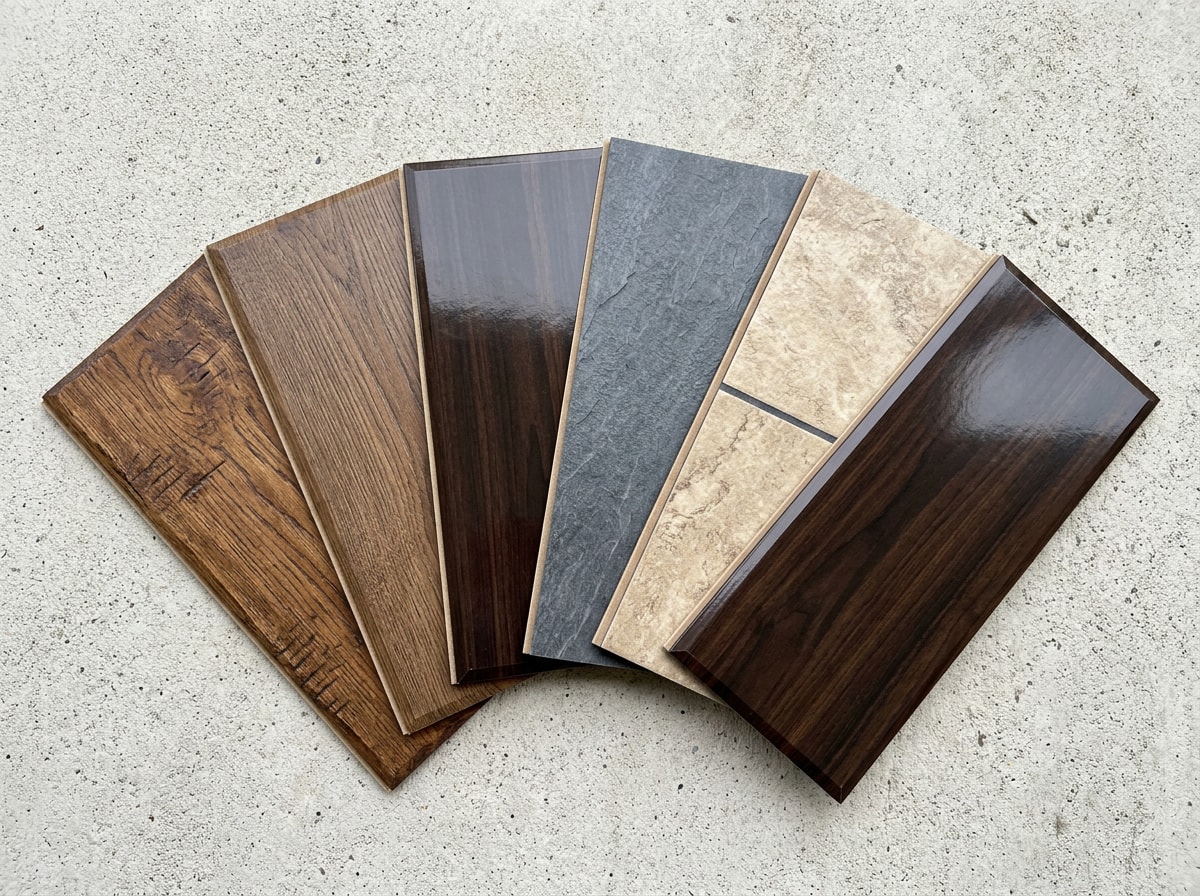
Wood look laminate dominates: oak, hickory, walnut, acacia. Stone look and tile look patterns with printed grout lines are widely available for entries and kitchens.
Then come the format choices:
- Plank width. Narrow strips through wide plank boards of seven inches or more.
- Finish. Smooth and high gloss, hand scraped, or wire brushed. Textured finishes hide dust and footprints far better.
- Bevel type. Micro beveled, painted bevel or square edge, which changes how distinct each plank reads once installed.
In Kihei condos, where floorplans are compact and already full of light, wider planks in lighter tones make rooms feel larger. Deep glossy finishes do the opposite, and they show every grain of sand.
Where to Install Laminate in a Kihei Home, and Where Not To
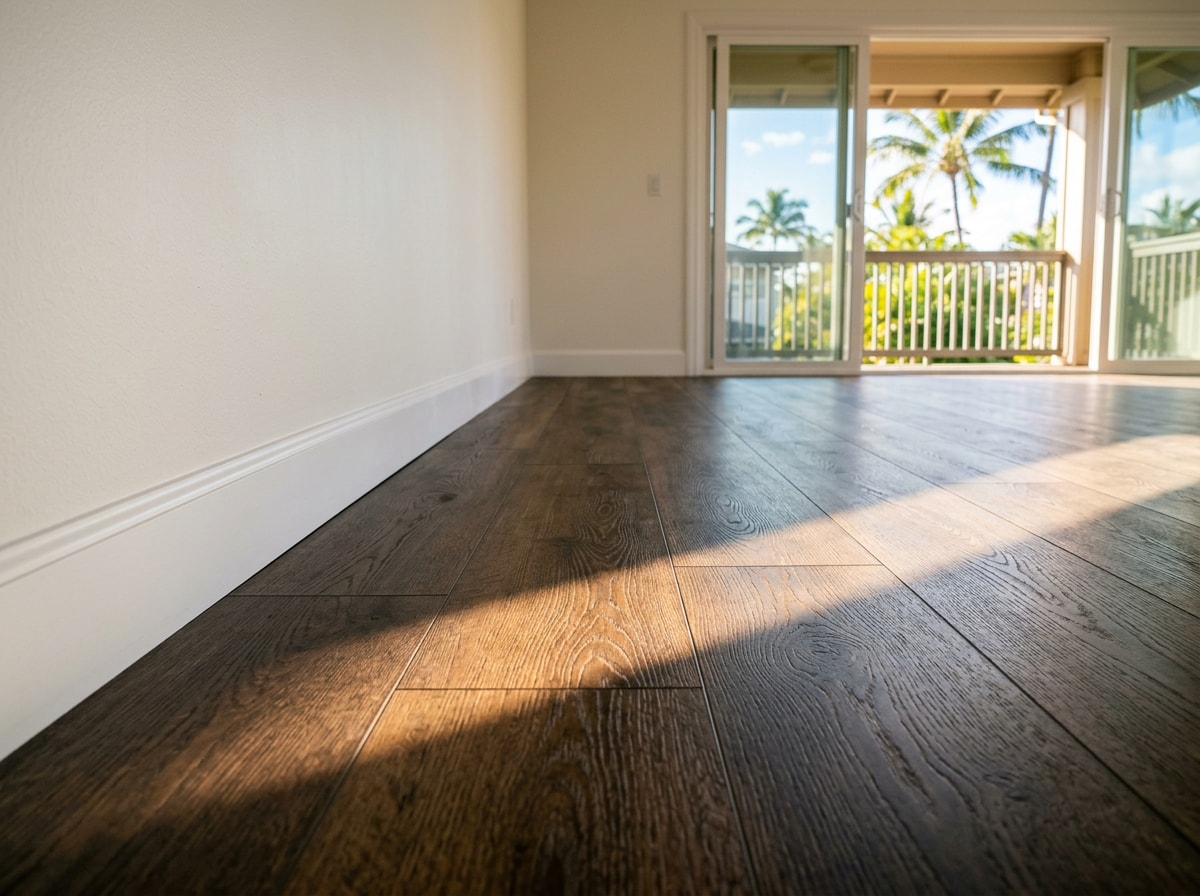
Laminate performs well in living rooms, hallways, bedrooms, home offices and rental units. Anywhere with normal foot traffic and no standing water.
Skip it in full bathrooms and laundry rooms. Be cautious on any slab subfloor without a proper vapor barrier.
Local conditions change the install, not just the product choice. Salt air, high ambient humidity and slab on grade construction all push moisture into the assembly from below and around.
Keeping indoor conditions stable helps. The EPA's guide to mold, moisture and your home advises keeping indoor humidity below 60 percent, ideally between 30 and 50 percent relative humidity . That is harder in a unit that sits open half the week.
So on site acclimation and correctly sized expansion gaps at every wall matter more here than in dry mainland climates. A floor installed tight will buckle.
We cover Kihei and the rest of Maui, and our flooring installation and repair services page explains how we prep slabs before a single plank goes down.
What We See on Actual South Maui Installs
One pattern repeats. In oceanfront units where sliders stay open and humidity swings daily, laminate seams telegraph movement far sooner than in mauka facing homes a mile inland with steadier indoor conditions.
Same product, same crew, different outcome.
Before we install, we let planks acclimate in the room for at least 48 hours with the A/C running the way the owner actually runs it, and we hold a quarter inch expansion gap at every vertical surface including door jambs and the back of the toe kick. On slabs we check moisture first, because a slab that reads high in September after a wet week will read differently in February, and the underlayment spec changes with it.
Skipping that step is the single most common reason we get called back to a laminate floor someone else installed.
Cleaning and Maintaining Laminate Floors
Routine care is simple:
- Dry sweep or vacuum on a hard floor setting.
- Damp mop, never wet, with a pH neutral laminate cleaner.
- Wipe spills immediately, especially along seams.
What ruins laminate: steam mops, which force heat and moisture into the joints. Wax and polish. Abrasive pads. Anything left standing.
For scratch prevention in a beach town, entry mats at every door and felt pads under furniture legs do more than any product you can buy. Sand is quartz. Ground underfoot, it works exactly like sandpaper on the wear layer.
Is Laminate Flooring Eco Friendly?
Laminate cores commonly use recycled wood fiber and sawmill by products, which is a real point in its favor. Many products carry low VOC certifications like FloorScore. The honest caveat is that laminate generally is not curbside recyclable at end of life.
Emissions matter most in a closed up, air conditioned condo where air exchange is low. The Formaldehyde Standards for Composite Wood Products Act of 2010 established emission standards for formaldehyde from composite wood products , and since March 22, 2019 those products, including medium density fiberboard and finished goods containing it, must be labeled as TSCA Title VI compliant . Check the EPA's formaldehyde emission standards page if you want the source language. A compliant, certified floor is a meaningful safeguard, particularly if anyone in the home is sensitive.
Ready to Price It Out?
If you want a straight answer on whether laminate is right for your unit, or whether tile or a coated concrete floor makes more sense, get a free estimate. We will look at the slab, the sun exposure and how the place gets used before recommending a product. More about our work at Luxe Pacific.
FAQ
What is the downside of laminate flooring?
It cannot be refinished. Damaged planks get replaced rather than repaired, so keep spare boxes from the original run. The second downside is moisture: locking seams are vulnerable to standing water, and a swollen core cannot be fixed once it happens.
Is laminate flooring waterproof?
Standard laminate is water resistant, not waterproof. Some lines are specifically waterproof rated with sealed joints. The weak point is the seam, not the plank face. Warranty coverage for standing water is time limited and varies by product, so confirm the terms in writing.
How long does laminate flooring last?
Roughly 15 to 25 years. Higher wear ratings, moderate traffic and consistent maintenance push you toward the top of that range. Coastal grit and swinging humidity shorten the low end, so a Kihei rental may age faster than the same floor upcountry in Kula.
Is laminate flooring better than vinyl?
It depends on the room. Laminate usually wins on underfoot feel, sound and visual realism because of its wood core. Vinyl wins in genuinely wet rooms and handles humidity better. The comparison table above shows the cost and lifespan differences.
How much does laminate flooring cost per square foot installed?
Plan on roughly $4 to $9 per square foot installed in South Maui, including underlayment and labor. Subfloor leveling, demo and haul away add to that. Freight and building access affect island pricing more than most people expect.
Can laminate flooring be installed in a kitchen or bathroom?
Kitchens are usually fine with a water resistant product and immediate spill cleanup. Full bathrooms and laundry rooms are not, because of standing water at the seams. Use tile or a coated concrete floor in those rooms instead.
Can you install laminate over existing tile or concrete?
Usually yes. Laminate floats, so it can go over sound tile or a clean slab as long as the surface is flat, dry and free of loose pieces. Slab moisture testing and a vapor rated underlayment come first. Badly cracked or hollow tile gets removed or repaired before anything floats over it.
What is the difference between laminate and engineered hardwood?
Engineered hardwood has a real wood veneer over a plywood core and can often be refinished once or twice. Laminate has a printed image under a resin wear layer and cannot be refinished. Laminate generally resists scratches better. Engineered wood generally adds more resale value.
How thick should laminate flooring be?
For most Kihei homes, 8mm to 12mm. Thicker planks feel more solid and hide minor subfloor variation, but thickness does not equal durability. Match the wear rating to the traffic first, then choose thickness for feel and sound.
Does laminate flooring add value to a home?
It reads as neutral to slightly positive with buyers, better than worn carpet and below real hardwood or quality tile. In a rental, the value is in durability and fast turnover cleaning rather than resale.
---
Written by the flooring team at Luxe Pacific, installers of laminate, tile, stone and decorative concrete across Maui and the neighbor islands. Questions about a specific product or slab? Reach us through our contact page.