Epoxy flooring contractors in Makena, HI face a tougher job than their mainland counterparts: salt air, heavy UV, and concrete slabs that trap more moisture than almost anywhere else in the islands. Skip the prep work and even premium resin lifts within a year or two. Here's what separates a floor that lasts fifteen years from one that bubbles before the first rainy season ends.
Why Makena's Climate Changes the Epoxy Equation
Resin chemistry isn't the weak link in most failed Hawaii epoxy jobs. Prep and testing are.
Island slabs carry more moisture vapor than typical mainland concrete, and that vapor pushes against a coating from underneath until it bubbles or peels. Reputable contractors measure this before committing to a system using ASTM F1869, a test method that covers the quantitative determination of the rate of moisture vapor emitted from below-grade, on-grade, and above-grade (suspended) concrete floors , with results expressed as pounds of moisture emission over a 1,000 ft² area during a 24-hour period .
Two details competitors rarely mention also matter:
- Cure time before coating. Per Sherwin-Williams technical guidance,
concrete must cure for a minimum of 28 days prior to the application of epoxy or urethane flooring systems . Pour a slab and coat it early to hit a deadline, and it will fail regardless of the product used.
- Film thickness on trowel-applied systems. The same guidance notes
for trowel-applied systems, the surface profile should be not less than 10 mils , a spec that's easy to shortcut if a crew is rushing.
UV exposure is the second variable. Direct sun on a lanai or pool deck will chalk and yellow an unprotected coating within a couple of Maui summers, which is why a polyurethane or polyaspartic topcoat, not the base epoxy, does the real UV work.
Where Epoxy Flooring Works at Home
Residential epoxy fits a handful of specific zones, each for a different reason:
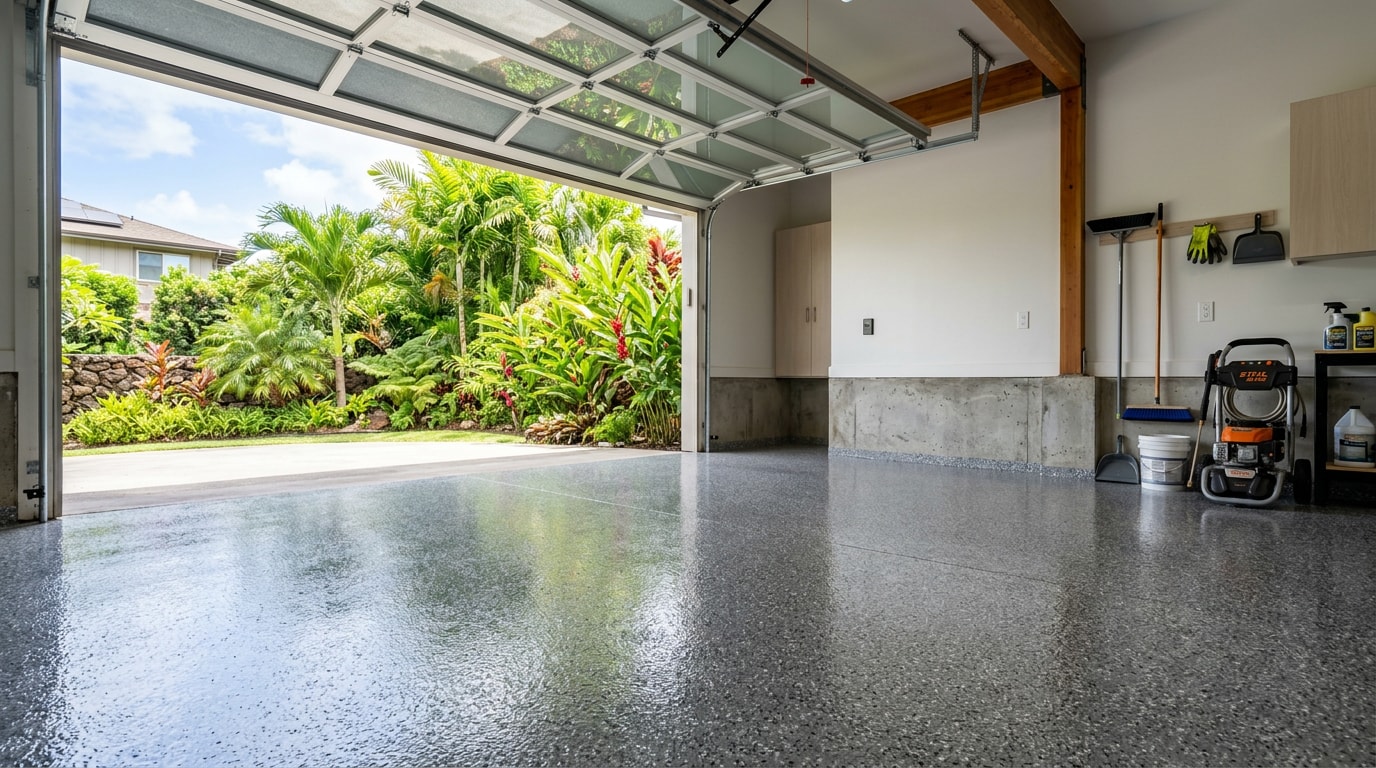
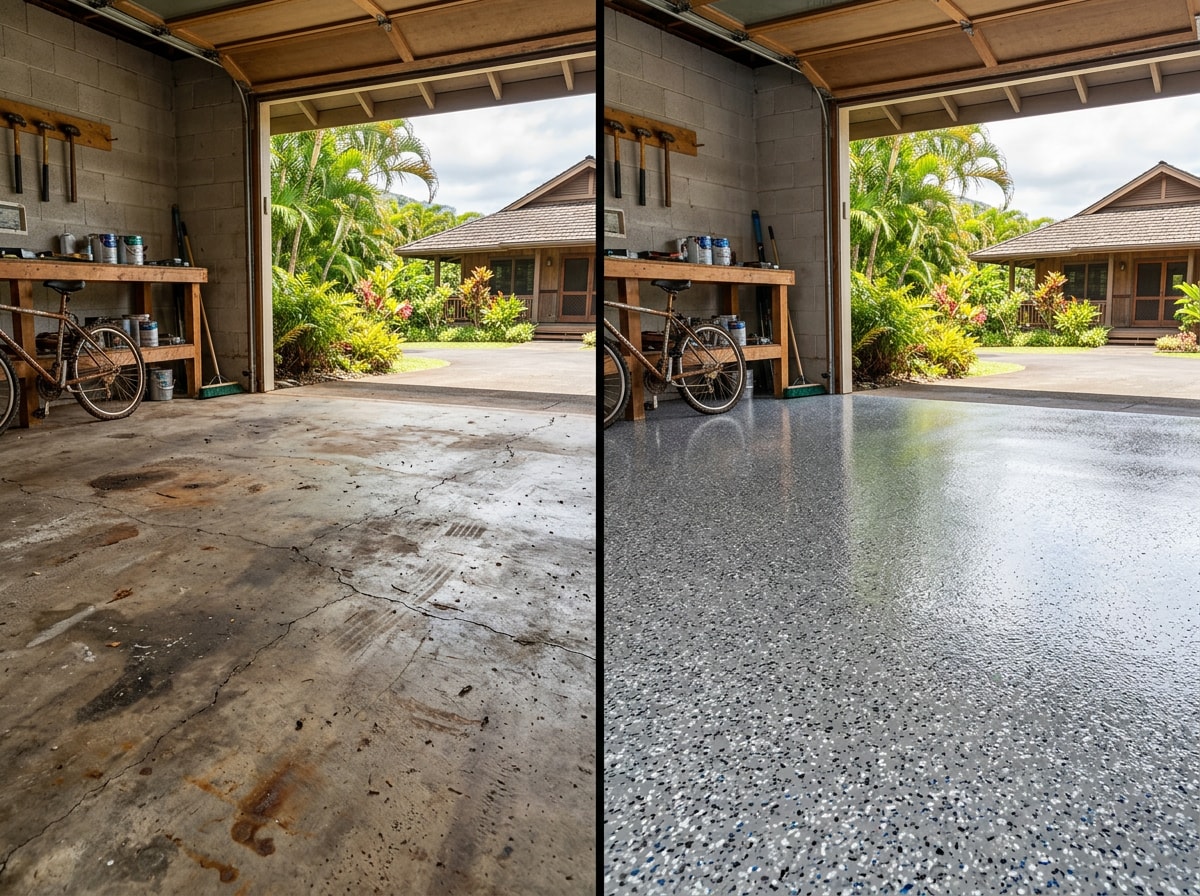
- Garage floors — the most requested upgrade, since it resists oil, tire marks, and gear storage wear.
- Lanais — extends naturally onto covered outdoor living space, assuming UV-stable topcoats are used.
- Kitchens and entryways — chosen for easy cleaning and a finished look.
- Storage and utility rooms — less common in Makena homes without basements, but still requested in multi-level builds.
Explore epoxy floor installation options to see which zones make sense for your property, or browse recent flooring projects for examples near Makena and Wailea.
Commercial Epoxy Flooring Around Makena and Wailea
Commercial epoxy work shows up most in the Makena and Wailea resort corridor: restaurant kitchens, hotel back-of-house areas, retail floors, and pool or spa decks. These spaces need slip-resistant flooring under constant foot traffic and water exposure, not just a durable coating.
Commercial floors in food service and hospitality settings are also measured against federal walking-surface safety rules. Under OSHA's walking-working surfaces standard, walking-working surfaces must be maintained free of hazards such as sharp or protruding objects, loose boards, corrosion, leaks, spills, snow, and ice . That's the baseline slip resistance gets engineered against, rather than added as an afterthought with a texture additive at the last minute.
How Installation Actually Works
Installation breaks into two stages: getting the concrete ready, then applying the coating system.
Surface Preparation
Grinding or shot-blasting the slab to the right surface profile is what creates real adhesion. Sherwin-Williams' technical team ties coating failures directly to this step, noting that proper drainage, vapor barriers, concrete mix design, curing and surface preparation before coating installation are what prevent blistering and disbondment down the line. Skip the grinding, and no topcoat will save the floor.
Epoxy Coating Application
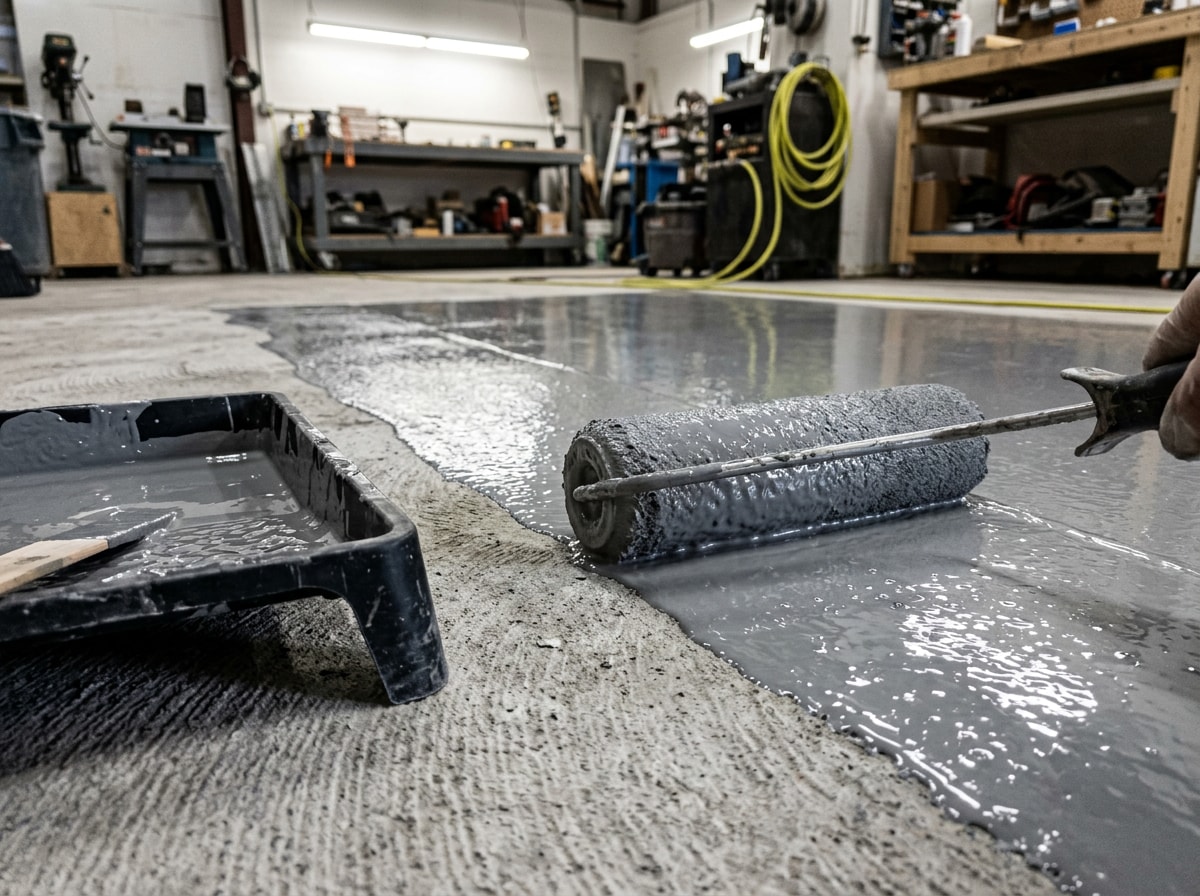
Crews apply the epoxy resin in multiple coats, allowing proper cure time between layers. A resin coating or polyaspartic topcoat goes on last for UV resistance and shine. On a well-prepped, well-tested slab, this combination typically performs for a decade or more; skip the testing, and even premium resin can lift within 18 months.
What Changes an Epoxy Floor's Price in Maui
Online estimates for Maui typically put epoxy flooring somewhere around $6 to $12 per square foot, but that range moves fast once slab condition and moisture mitigation enter the picture. Shipping materials to the islands and a smaller local labor pool also push pricing above mainland averages.
| Factor | Why It Changes the Price |
|---|---|
| Slab moisture reading | Slabs that fail ASTM F1869 testing need a vapor-mitigating primer, adding labor and material cost |
| Existing floor condition | Cracks, spalling, or old coatings require extra grinding or patching before any epoxy goes down |
| System type | Solid color costs less than flake or metallic systems, which need more coats and more install time |
| Square footage and access | Small, broken-up areas (lanais, entryways) often cost more per square foot than one open garage slab |
Treat any online range as a starting point, not a quote. Request a free on-site estimate for pricing specific to your Makena property, or see how costs break down further in this epoxy flooring cost guide for nearby Kapalua.
If epoxy isn't the right fit for every surface in your home, Luxe Pacific's broader flooring installation and repair and concrete finishing and customization categories cover decorative concrete, polished concrete, and overlay systems for areas where epoxy isn't the best match. Service is available across Maui, including Wailea and Makena directly.
FAQ
Do you install epoxy floors?
Yes. Epoxy systems cover solid color, flake, and metallic finishes for garages, lanais, and commercial spaces, with the system matched to the surface and expected traffic. Get in touch to discuss which system fits your floor.
Why does epoxy fail in Hawaii?
Most failures trace back to skipped moisture testing or weak UV protection, leading to peeling, bubbling from moisture pressure, or yellowing over time. It's rarely a flaw in the epoxy itself.
Is polyaspartic worth it over epoxy?
Polyaspartic and polyurea topcoats cure faster and resist UV better than standard epoxy topcoats. Many Maui installs now pair an epoxy base coat with a polyaspartic topcoat to get adhesion and UV stability in one system.
How long does epoxy flooring last in Maui's climate?
A properly tested and prepped floor typically lasts a decade or more. Lifespan drops sharply on floors where moisture testing or surface grinding was skipped.
Is epoxy flooring slippery when wet?
Not when it's specified correctly. Pool decks, spa areas, and commercial kitchens get a broadcast aggregate or slip-resistant additive built into the topcoat, rather than relying on a smooth, glossy finish in a wet-traffic area.
Start with a floor built for the slab, the sun, and the salt air it'll actually face. Visit the homepage to see the full range of services, or request your free estimate today.